






Revolutionizing Retail Efficiency: The Complete Guide to Electronic Shelf Labels

The retail industry stands at the brink of a technological revolution, and Electronic Shelf Labels are leading the charge. Traditional paper labels have long been a source of inefficiency, errors, and unnecessary labor costs. According to industry data, retailers spend approximately 200-300 hours annually on price changes alone when using manual labeling systems. This comprehensive guide explores how ESL technology transforms retail operations through automated pricing systems.
The Problem with Traditional Pricing Systems
Paper labels create significant operational challenges that impact both profitability and customer experience. The manual process of changing prices is not only time-consuming but also prone to human error. Studies show that pricing errors occur in approximately 5-8% of items in a typical supermarket using paper labels, leading to either revenue loss or customer dissatisfaction.
Labor-intensive price changes require staff to focus on administrative tasks rather than customer service. During promotional periods, the problem magnifies as staff must work overtime to ensure all price changes are implemented correctly. This inefficient system ultimately affects the bottom line and creates a poor shopping experience.
The ESL Solution: A Connected Store Ecosystem
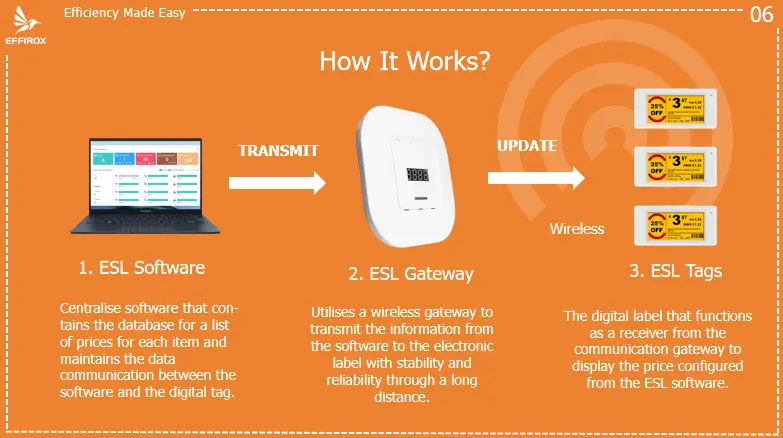
Electronic Shelf Labels represent a paradigm shift in retail pricing management. The EFFIROX system comprises three integrated components that work seamlessly together:
1. Centralized ESL Software: This web-based dashboard serves as the command center for all pricing operations. The software maintains a comprehensive database of product prices and manages communication between the system and digital tags. With multilingual support across 11 languages, the platform ensures accessibility for global retail operations.
2. ESL Gateway Infrastructure: Utilizing a private 2.4GHz wireless network, the gateway transmits pricing information from the software to electronic labels with remarkable stability and reliability. Each gateway covers a radius of 20 meters (approximately 1200 square meters indoors) and can support up to 2,000 ESL tags, making it suitable for stores of all sizes.
 
3. ESL Tags: Available in various sizes and specifications, these digital labels display pricing information received from the gateway. The tags feature innovative screen segmentation capabilities, allowing multiple products to be displayed on a single screen, maximizing space utilization.
 
Key Benefits and ROI
Implementing an ESL system generates substantial returns across multiple dimensions:
  • Labor Cost Reduction: Automated price updates eliminate manual label changes, saving hundreds of labor hours annually. Stores typically recover their ESL investment within 12-18 months through labor savings alone.
  • Pricing Accuracy: Real-time synchronization ensures 100% consistency between shelf prices and point-of-sale systems, eliminating pricing disputes and compliance issues.
  • Enhanced Promotional Capabilities: retailers can implement flash sales, seasonal promotions, and dynamic pricing strategies with unprecedented flexibility. The system allows pre-scheduling of price changes, ensuring perfect timing for marketing campaigns.
Implementation Considerations
Successful ESL deployment requires careful planning regarding:
  • Store layout and gateway placement
  • Integration with existing POS and inventory systems
  • Staff training and change management
  • Data security and system maintenance
Future Trends
The evolution of ESL technology continues with advancements in:
  • Integration with IoT devices
  • Advanced analytics capabilities
  • Personalized pricing displays
  • Enhanced customer interaction features
Electronic Shelf Labels represent more than just a technological upgrade; they signify a fundamental transformation in retail operations. By automating pricing processes, enhancing accuracy, and enabling dynamic pricing strategies, ESL systems position retailers for success in an increasingly competitive marketplace. The future of retail pricing is digital, and the transition begins with implementing a robust ESL solution.